
2026-10-10 · Ropa Perfumes
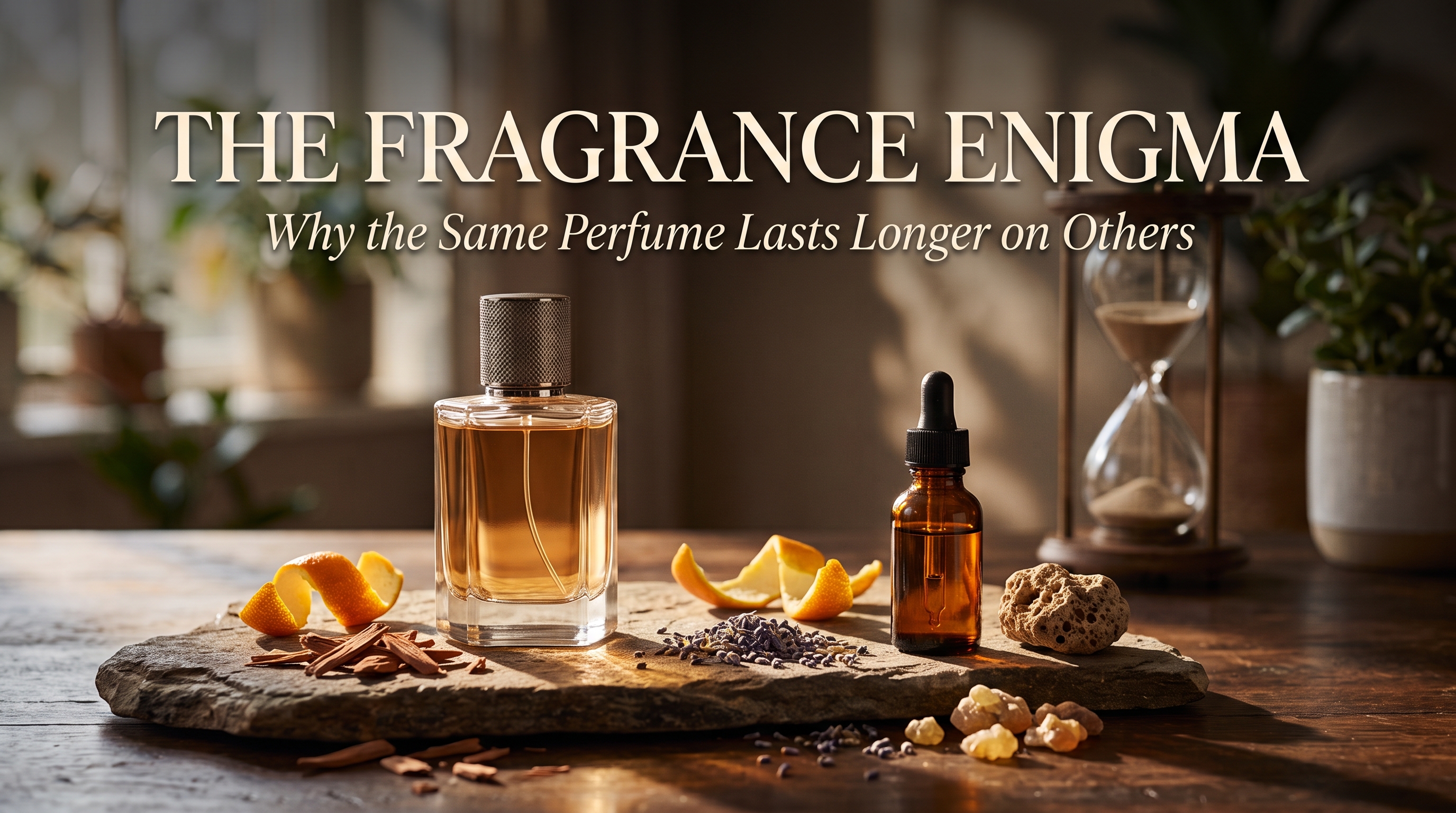
The Fragrance Enigma: Why the Same Perfume Lasts Longer on Others
Have you ever bought a highly praised, long-lasting perfume only to find it vanishes on your skin within hours? The secret lies in a mix of skin chemistry, environment, and olfactory biology. Here is why fragrances perform differently on everyone, and how you can finally boost your scent’s longevity and projection.
You’ve done your research. You watched the reviews, read the forums, and finally purchased a fragrance that everyone describes as a "beast mode" scent with massive projection and 12-hour longevity. But when you spray it on, it becomes a faint skin scent within two hours. Meanwhile, your friend wears the exact same perfume, and it fills the room all day.
If this sounds familiar, you are not alone. The phenomenon of a fragrance performing drastically differently from one person to another is one of the most common and frustrating aspects of perfumery.
So, why does perfume last longer on some people and not on others? And more importantly, how can you fix it? Let's dive into the science of scent, skin chemistry, and the best mitigations to boost your fragrances performance.
Why Perfumes Perform Differently: The Main Culprits
1. Skin Chemistry: Oily vs. Dry Skin
The most significant factor in fragrance longevity is your skin type. Perfumes are composed of essential oils and alcohol.
- Oily Skin: People with naturally oily skin tend to hold onto fragrances much longer. The natural sebum (oil) on the skin traps the fragrance molecules, preventing the alcohol from evaporating too quickly and releasing the scent slowly over time.
- Dry Skin: If you have dry skin, the alcohol and fragrance oils evaporate rapidly because there is no lipid barrier to anchor them. The skin quite literally "drinks" the perfume, causing both projection and longevity to plummet.
2. Olfactory Fatigue (Nose Blindness)
Often, the perfume is projecting, but you just can't smell it anymore. Our brains are hardwired to filter out continuous, unchanging stimuli to stay alert to new environmental changes. If you wear a strong fragrance, especially one with heavy synthetic musks or Iso E Super, your scent receptors may shut off after 30 minutes. You might think the fragrance has vanished, but the people around you can still smell it clearly.
3. Body Temperature and Climate
Fragrance is activated by heat.
- Heat and Humidity: In warm, humid environments, perfumes project massively. The heat causes the alcohol to evaporate faster, pushing the scent molecules into the air. However, this also means the perfume will burn off your skin much faster, reducing longevity.
- Cold and Dry: In colder weather, the fragrance stays close to the skin. It will last significantly longer but won't project as much. Additionally, individuals with naturally higher body temperatures will burn through top and heart notes faster than those who run cold.
4. Diet, Hydration, and Medication
What you put into your body alters your natural skin odor and pH levels. Spicy foods, strong aromatics (like garlic and onion), red meat, and certain medications can subtly change how your sweat and sebum smell. When these natural odors mix with your perfume, they can either amplify the notes or completely distort them, affecting how strongly the scent projects.
5. Batch Variations and Reformulations
Sometimes, it really isn't you, it's the bottle. Due to changing regulations (such as IFRA restricting certain raw ingredients like oakmoss or specific musks), fragrance houses frequently reformulate their scents. A bottle produced in 2018 might have incredible performance, while a 2024 batch of the "same" fragrance might be watered down.
Mitigations: How to Make Your Perfume Last Longer and Project More
If you find that your skin eats fragrances, don't give up on your favorite bottles just yet. Here are proven strategies to maximize projection and longevity.
1. The Moisturizer Method
Since dry skin is the primary enemy of perfume longevity, you need to create an artificial lipid barrier.
- Action: Apply an unscented body lotion, body oil, or a thin layer of Vaseline (petroleum jelly) to your pulse points right before spraying your perfume. The fragrance oils will cling to the moisturizer instead of sinking into your pores.
2. Target the Right Pulse Points
Heat helps project the fragrance. Target areas where the blood vessels are closest to the skin:
- Behind the ears
- The base of the throat
- Inner elbows
- Wrists (But never rub your wrists together! Rubbing creates friction that breaks down the delicate top notes of the fragrance, causing it to fade faster).
3. Spray on Your Clothes and Hair
Fabric and hair hold onto scent far longer than skin.
- Action: If your skin chemistry is neutralizing the perfume, spray a few pumps onto your shirt or jacket. (Be careful with dark-colored juices on white fabrics to avoid staining). You can also spray perfume onto a hairbrush and run it through your hair, which acts as a fantastic scent diffuser when you move.
4. Layer Your Fragrances
Scent layering builds a stronger foundation for your perfume.
- Action: Use a matching scented body wash, followed by a matching body lotion, and finish with the Eau de Parfum. If you don't have matching products, layering your fragrance over a complementary essential oil (like vanilla or sandalwood) can drastically improve the dry-down longevity.
5. Store Your Perfume Correctly
Light, heat, and humidity break down the molecular structure of perfume, weakening its performance over time.
- Action: Keep your fragrances out of the bathroom. Store them in a cool, dark place, like a closet or a drawer, preferably in their original boxes.
Final Thoughts
Fragrance is a deeply personal and biological experience. While it can be frustrating to see a perfume perform beautifully on someone else while fading on you, understanding your skin chemistry is the first step to mastering your scent bubble. By adjusting your application techniques and keeping your skin hydrated, you can force even the most fleeting fragrances to go the distance.